A fiddle leaf fig plant can give a living room the height, texture, and architectural shape that furniture alone cannot provide. It can also become frustrating when a bright-looking room is actually too dim, watering is based on a calendar instead of the soil, or a newly purchased plant is moved repeatedly. This guide gives you a practical setup: choose a healthy plant, match it to the right window, establish a repeatable watering routine, and troubleshoot changes before they become expensive or dramatic.
The goal is not to make a fiddle-leaf fig grow as quickly as possible. The goal is steady growth with predictable maintenance in the particular home you have, whether that is a sunlit house, a north-facing apartment, or a carefully styled interior-design project. Treat the policies below as illustrative starting policies for 2026, not universal rules. The plant’s soil, leaves, light, season, and pot all provide signals that should make you adjust them.
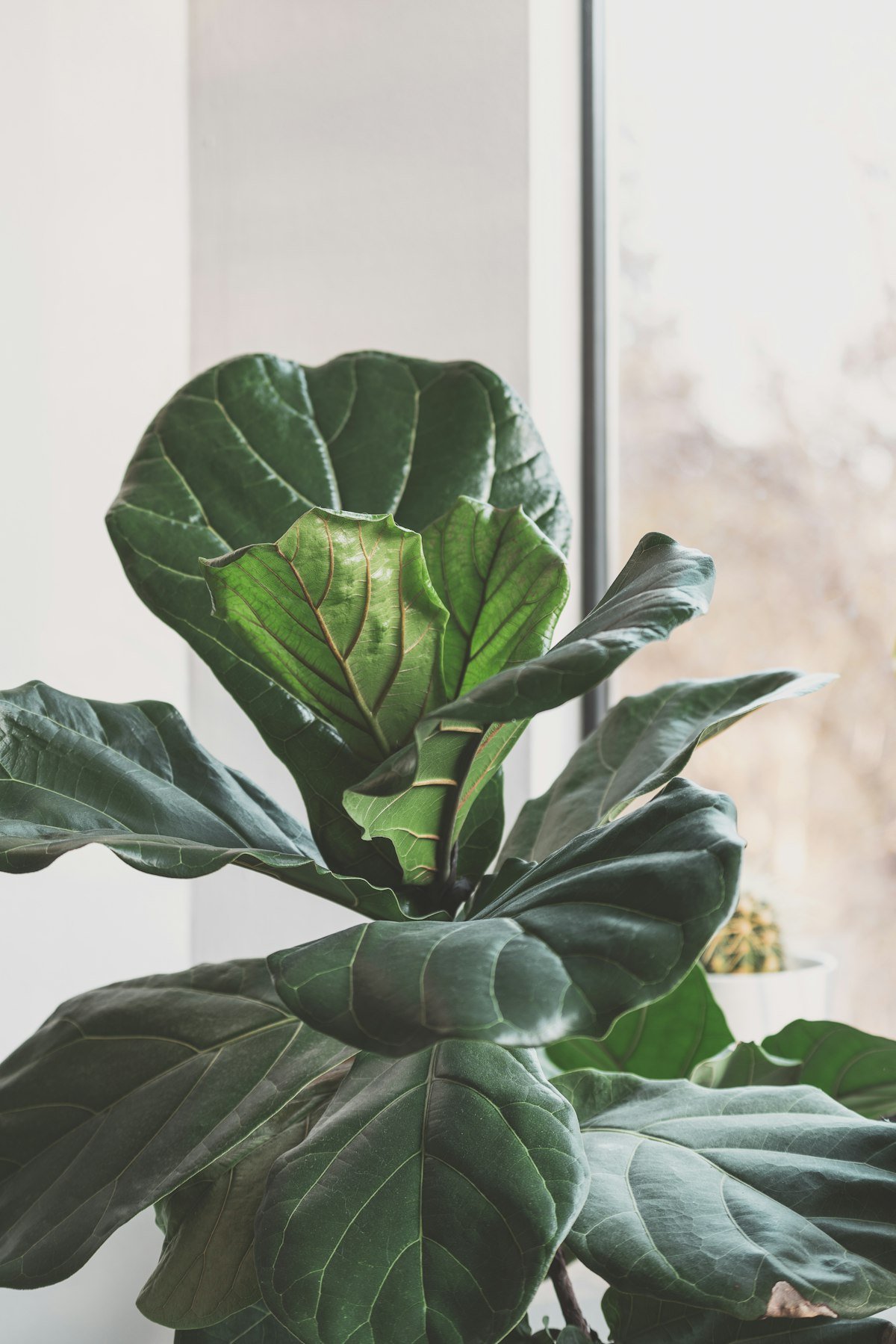
Choose a plant that can recover from the move
Start with the plant itself, not the decorative basket or the height it will occupy beside a sofa. A fiddle-leaf fig is Ficus lyrata, a tropical tree grown indoors for its large, violin-shaped leaves. The North Carolina Extension Gardener Plant Toolbox describes it as a plant that prefers bright light and well-drained soil, while also noting that its mature size can become substantial indoors or in suitable outdoor climates (North Carolina State Extension, 2026: Ficus lyrata plant profile). That makes the initial selection a space-planning decision as much as a plant-care decision.
Inspect the leaves, stems, and root zone
Look for a plant with a stable central stem, evenly attached leaves, and fresh growth that is firm rather than limp. A few cosmetic marks are not automatically a problem; large leaves are easily scuffed during transport. What matters is whether damage is isolated or spreading.
- Leaves: reject a plant with widespread yellowing, a sour smell, webbing, sticky residue, or many expanding brown spots.
- Stems: choose stems that are upright and firm, without soft dark sections or cuts that look wet.
- Soil: avoid persistently saturated compost, standing water, or a pot that feels much heavier than expected for its size.
- New growth: a developing leaf is useful evidence that the plant has recently been growing, although it is not a guarantee that it will transition easily to your home.
- Scale: check the mature footprint before buying a tall specimen that leaves no room for the canopy to expand.
Do not select the biggest plant automatically. A smaller plant that fits your brightest available location may outperform a taller specimen placed several feet farther from a window. For apartment dwellers, window compatibility beats display size. For designers, record the plant’s height, pot width, canopy width, and the exact destination before approving it for a room set.
Quarantine before styling the plant
Keep a new plant separate from your collection while you inspect it over time. This is an illustrative starting policy: use a two-week observation period, then extend it if you see new pests, fresh leaf damage, or unexplained decline. The signal to adjust is not the calendar; it is evidence that a pest or disease may still be active.
During that period, examine both sides of leaves, leaf joints, and the soil surface. Wipe dust with a clean, damp cloth only if the leaves are sturdy enough to handle it. Avoid immediately repotting, fertilizing, pruning, and relocating the plant all at once. Too many interventions remove your ability to tell which change helped or harmed it.
Map the room before choosing the permanent location
Light is the main constraint for a fiddle-leaf fig, and the brightest place in a room is not always the place that looks brightest from the doorway. A window filtered by sheer fabric can provide a very different amount of usable light from a plant placed deep inside the room. The Royal Horticultural Society describes Ficus lyrata as suited to bright, indirect light and warm indoor conditions (RHS, 2026: Ficus lyrata details). Use that as a direction, then translate it to your home rather than treating “bright indirect” as a decorative label.
Use a three-part light test
- Stand where the plant will sit and note whether the window is visible without looking around a corner.
- Observe the area at several times of day, including the part of the day when direct sun reaches the glass.
- Check what blocks the light: a neighboring building, deep overhang, blackout curtain, large furniture, or another plant’s canopy.
An illustrative starting policy is to place the plant within a few feet of the brightest suitable window, while protecting it from a sudden transition from dim retail lighting to intense hot glass. The signal to move it closer is long, weak new growth, small new leaves, or a plant that consistently leans toward the window. The signal to move it farther away or filter the light is pale, bleached-looking patches that appear on the window-facing surface, especially after a rapid relocation.
Rotate the pot only when you have a reason. A quarter-turn every one to two weeks is an illustrative starting policy for balancing a one-sided canopy; adjust it if the plant repeatedly twists, drops leaves after turning, or has a fragile stem. In a minimalist interior, do not rotate merely to make every leaf face the camera. A stable light direction often helps you understand how the plant is responding.
Account for drafts, heat, and access
A plant may receive adequate light and still struggle beside a heating vent, radiator, frequently opened exterior door, or air-conditioning outlet. These locations can dry leaves and soil unevenly. Keep enough clearance for you to check the pot and clean the leaves. A beautiful plant trapped behind a console is difficult to inspect, and neglected inspection is how small problems become hidden root or pest problems.
Use this room decision checklist before committing to a location:
- Can you reach the soil without moving heavy furniture?
- Does the plant have a clear path to the window rather than only a view of it?
- Will curtains, shutters, or seasonal decor change its light?
- Is the pot protected from bumping by pets, children, doors, and robot vacuums?
- Can excess water drain without damaging wood flooring or a woven rug?
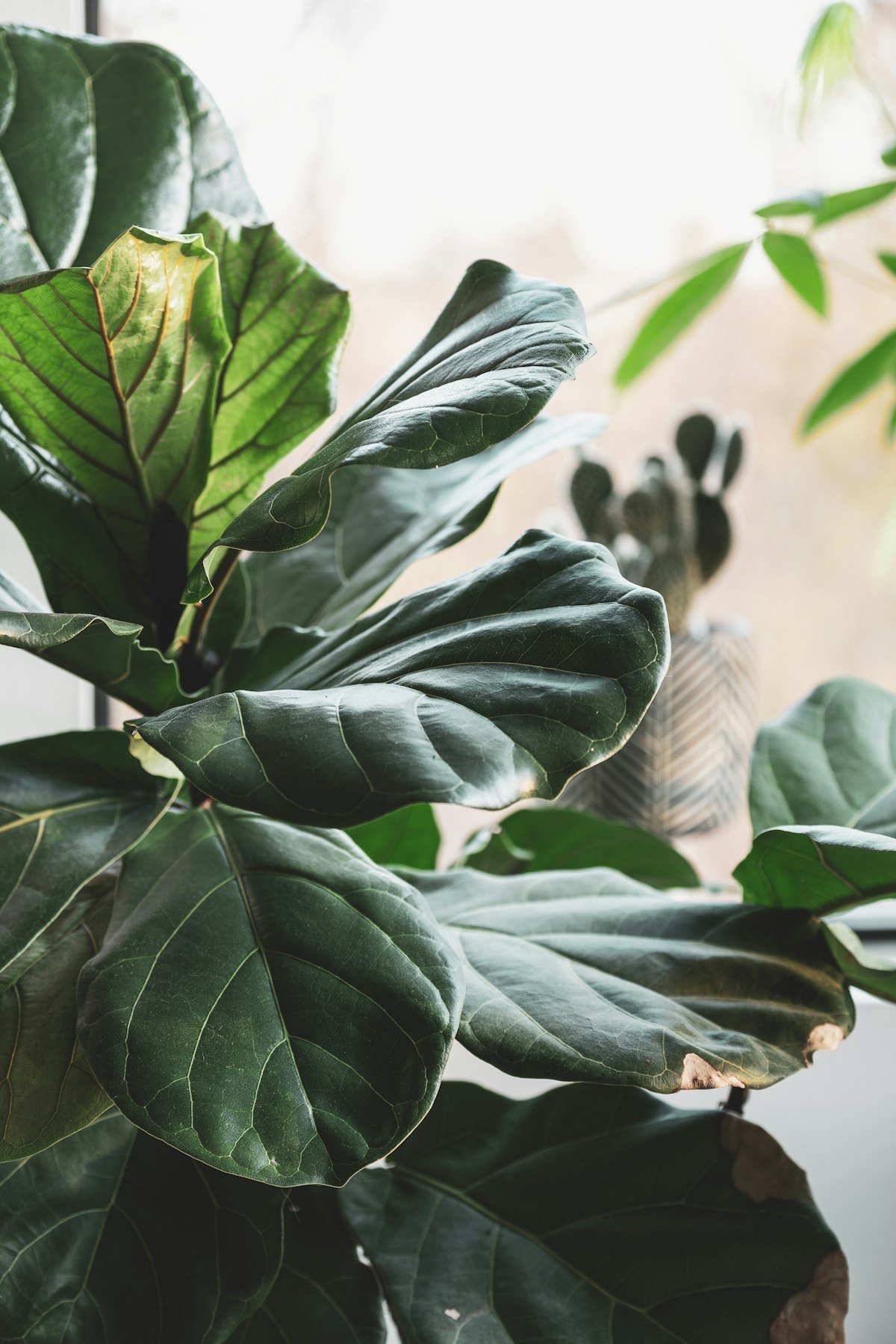
Build the pot and soil system before the first watering
Many “watering problems” begin with a container problem. A decorative cachepot without a drainage outlet can hold water around the nursery pot, and a pot that is far larger than the root ball can remain wet for too long. Fiddle-leaf figs need moisture, but roots also need access to air. Your job is to create a system where water can pass through and the plant can be checked easily.
Use a draining inner pot
Keep the plant in a nursery pot with drainage holes inside a decorative container, or use a planter that drains into a saucer. After watering, empty collected water rather than letting the root zone sit in it. The pot should be stable enough for the canopy but not so oversized that the soil stays wet long after the roots have used available moisture.
As an illustrative starting policy, choose a replacement pot only modestly wider than the current root ball when repotting. Adjust smaller if the soil remains wet for many days, the plant is recently stressed, or the root ball is not holding together. Adjust larger only when roots are densely circling, emerging from drainage holes, or leaving very little soil available for moisture. The signal is the condition of the root ball, not the desire to give a tall plant a more impressive container.
Do not place gravel in the bottom as a substitute for drainage. A gravel layer can create a perched layer of wet soil above it instead of solving the underlying issue: too much water and too little usable drainage space. Use a well-draining houseplant mix, and avoid compacting it tightly around the roots.
Repot for a reason, not on arrival
Immediate repotting is sometimes necessary if the pot is broken, the soil is foul-smelling and saturated, or roots are clearly rotting. Otherwise, allow the plant to settle before changing its root environment. A move from a bright nursery or greenhouse into a home already creates a light and humidity transition.
When you do repot, inspect the roots gently. Healthy roots are generally firm; soft, collapsing, or dark roots call for removal of only the clearly damaged material with clean tools. Do not strip every bit of soil simply because it looks different from your preferred mix. Preserve healthy roots, replant at the same depth, and water according to the new soil’s condition rather than a fixed schedule.
Water by checking the root zone
Watering is not “a cup every Sunday.” The same plant can need water at different intervals as daylight, temperature, pot size, airflow, and root mass change. The University of Minnesota Extension recommends checking houseplant moisture rather than relying only on a calendar, and explains that watering needs vary with the plant, container, growing medium, and environment (University of Minnesota Extension, 2026: Watering houseplants).
Use a repeatable check-and-water method
- Check the soil below the surface with a finger or wooden stick, not only by looking at the top crust.
- Lift the pot occasionally so you learn the difference between a recently watered pot and a dry one.
- When the root zone has dried to the level appropriate for your plant and room, water slowly and evenly until some drains from the bottom.
- Let the pot drain fully, then empty the saucer or cachepot.
- Record the date only as a clue for the next check, not as an automatic command to water.
A check once each week is an illustrative starting policy for a newly placed plant. It is not a watering interval. Check more often if the room is warm, bright, and airy; check less often if the room is cool, dim, or the pot is large relative to the root ball. The signal to shorten the interval is a repeatedly limp plant or soil that becomes extremely dry before your next check. The signal to lengthen it is soil that stays wet and heavy between checks, especially if lower leaves yellow.
Water quantity should match the container and root zone. A tiny sip can wet only the upper layer and encourage roots to remain shallow. Repeated flooding of a poorly draining pot can deprive roots of air. This is why thorough watering followed by appropriate drying is more useful than a fixed volume copied from another home.
Separate thirst from root stress
A drooping plant is not automatically thirsty. If the soil is already wet, adding water may worsen the cause. Brown edges can reflect inconsistent moisture, dry air, root injury, salt accumulation, or leaf contact with a hot window. Diagnose the pattern rather than treating one symptom.
| What you observe | Most useful first interpretation | Next action |
|---|---|---|
| Leaves droop while the soil is clearly dry | The plant may be under-watered or the root ball may have pulled away from the pot | Water thoroughly, confirm drainage, and recheck the response rather than adding daily sips |
| Leaves droop while the soil is wet and heavy | Roots may be stressed by prolonged saturation, poor drainage, or recent repotting | Pause watering, inspect drainage, and move to brighter suitable light without adding heat |
| Lower leaves yellow gradually | Older leaves may be aging, but persistent wetness or low light also deserves attention | Check the root zone and light before removing leaves |
| Dry brown margins on several leaves | Moisture swings, dry airflow, root disturbance, or salt buildup are possible | Review watering consistency and the location; inspect roots if decline continues |
| New spots multiply or show halos | Possible pest or disease issue rather than simple thirst | Isolate, inspect both leaf surfaces, and avoid wetting foliage unnecessarily |
This table is a decision aid, not a diagnostic laboratory. The adjustment signal is a pattern over time: new symptoms, spreading damage, or a mismatch between the soil and the plant’s appearance.
Maintain leaves, roots, and shape without overcorrecting
Care becomes easier when you divide it into observation, cleaning, feeding, and pruning. The large leaves collect dust, but aggressive rubbing can damage their surface. Likewise, pruning is useful for shape and safety, not a requirement to make every plant look perfectly branched.
Clean and inspect with a light touch
Wipe broad leaves with a soft, damp cloth when dust blocks their surface or affects the room’s appearance. Support the leaf from underneath instead of dragging it against a hard edge. Avoid oily shine products: they can leave residue, attract dust, and make it harder to see pests or spotting.
Use an illustrative twice-monthly leaf inspection during active growth, increasing the frequency if the plant is near an open window, pet bedding, or other plants with known pest problems. The signal to inspect more often is fresh stippling, fine webbing, cottony clusters, scale-like bumps, or sticky residue. The signal to stop escalating treatment is clean new growth and no spread after repeated observations.
For a pest issue, isolate the plant first. Remove heavily damaged leaves only when they are unlikely to recover or are clearly dead. Identify the pest before choosing a treatment, and follow the product label exactly. The University of Illinois Extension discusses common houseplant pests and emphasizes inspecting plants and using appropriate control methods rather than treating every symptom identically (University of Illinois Extension, 2026: Houseplant pests).
Feed and prune according to growth
Fertilizer cannot compensate for inadequate light, damaged roots, or poor drainage. If the plant is actively producing new growth, use a complete houseplant fertilizer according to its label. An illustrative starting policy is to begin with a diluted feeding during the active growing period, then adjust based on new growth, leaf color, and salt buildup. Follow the label rather than inventing a stronger concentration. Pause feeding when the plant is declining or the soil is staying wet; stressed roots are not improved by more nutrients.
Prune with a clean, sharp tool when a stem is dead, damaged, unsafe, or growing in a direction that conflicts with the room. Make a deliberate cut rather than repeatedly nicking the stem. Expect the plant to respond according to its light and growing energy; pruning cannot force a full canopy in a dim corner.
Keep a simple care record:
- date of watering and whether the pot drained freely;
- location and any major change in window covering or furniture;
- new leaves, dropped leaves, or spreading spots;
- fertilizer use and the product label’s dilution;
- pest inspections and what you observed before treating.
That record is particularly valuable for interior designers managing several homes or for plant enthusiasts with multiple specimens. It replaces vague impressions such as “it always seems unhappy” with a sequence of conditions you can change one at a time.
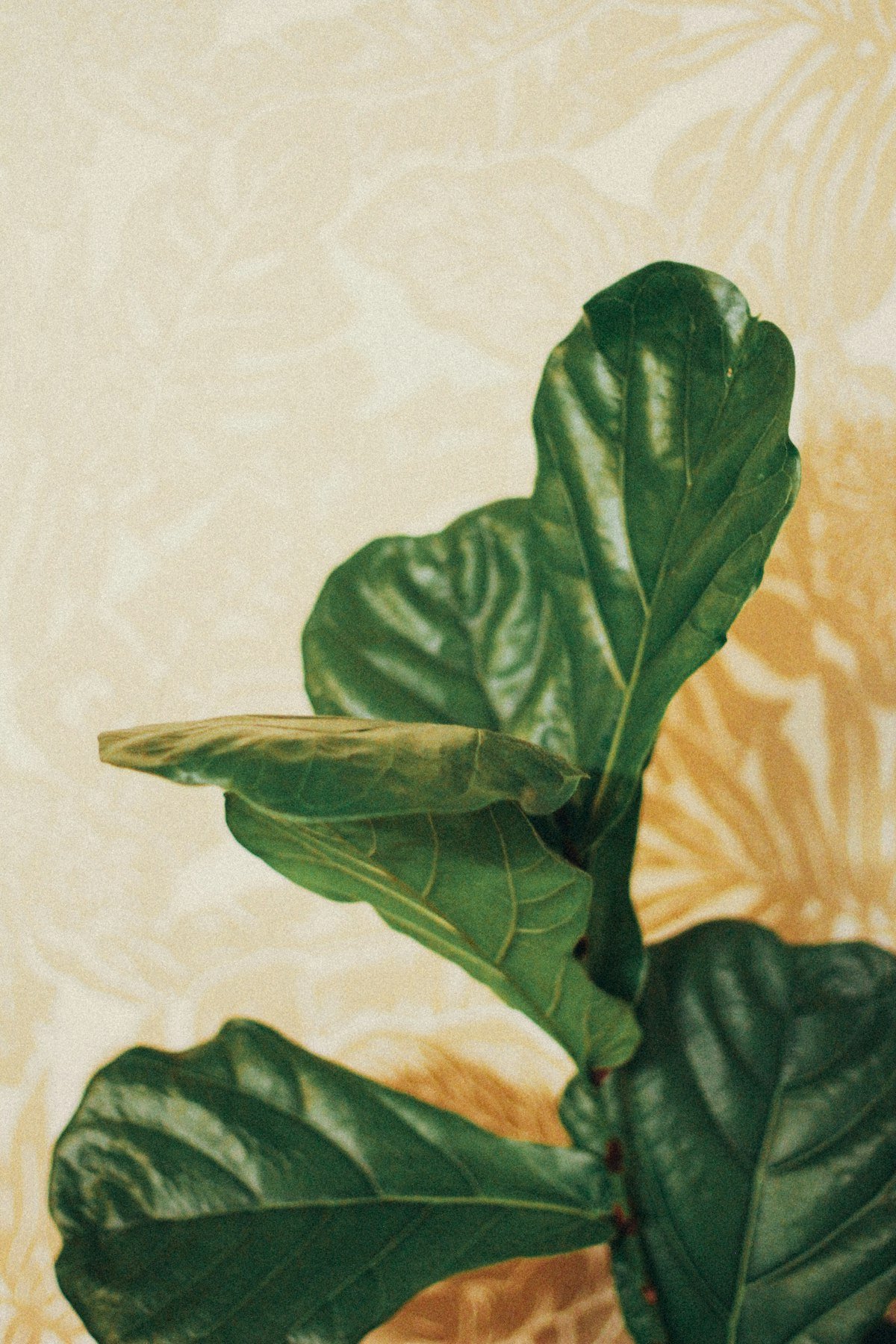
Apply the plan to a real minimalist living room
Consider a worked example: a homeowner has a two-metre-wide living-room window, a pale wood floor, a neutral sofa, and a fiddle-leaf fig in a small nursery pot. The desired result is a tall focal point that does not crowd the seating area. The room receives strong morning light, but a sheer curtain is usually closed and the plant would sit behind the sofa if placed at the most convenient styling point.
Turn the design brief into plant decisions
First, place the plant beside rather than behind the sofa so the canopy has a clearer path to the window. Keep the nursery pot inside a stable cachepot with a way to remove drained water. The homeowner photographs the location in the morning and afternoon, then checks whether the curtain changes the light more than expected.
Next, they use the following illustrative starting policy: inspect the soil weekly, water only when the root zone has dried appropriately, rotate the pot every one to two weeks if the canopy leans, and inspect leaves twice monthly. These are prompts for observation, not promises about how often water will be needed. If the soil remains damp at every weekly check, the homeowner adjusts the watering interval and investigates pot size, drainage, and light. If new leaves become smaller and the stem leans, the plant moves closer to the window rather than receiving extra fertilizer.
Finally, the homeowner avoids styling the pot on a rug unless a saucer or waterproof barrier protects the floor. The visual plan now supports the biological plan: the plant has light, drainage, access for inspection, and enough clearance to grow without being knocked over. That is the important design trade-off. A slightly less symmetrical arrangement that keeps the plant healthy is more sustainable than a perfect arrangement that forces it into shade.
Know when a different plant is the better decision
Sometimes the correct outcome is not persuading a fiddle-leaf fig to tolerate a room. If every suitable location is dim, inaccessible, or exposed to severe drafts, choose a plant whose needs match the space. A low-maintenance brief should not be solved by buying a demanding specimen and hoping care will make up for the mismatch.
If pets may chew leaves, check the species before bringing it home. The ASPCA lists Ficus species among plants that can cause gastrointestinal irritation and other signs in pets, with symptoms and severity depending on the animal and exposure (ASPCA, 2026: Ficus and pet safety information). Keep the plant inaccessible where needed and contact a veterinarian or animal poison service if ingestion occurs.
What to do first today
Take a photo from the exact place where you want the plant to live, then stand there at the brightest part of the day and check whether the window is visible, the light is blocked, and the pot can be reached without moving furniture. That single test prevents the most common decorating mistake: choosing a plant for its size and discovering later that its location cannot support it.
Next, choose a healthy specimen with a draining inner pot, isolate it for an illustrative two-week observation period, and begin a written soil check once each week. Adjust those starting policies when the plant’s signals disagree with them: persistent wetness, dry soil before the next check, leaning growth, new spots, or repeated leaf drop. For a plant that fits your room and care routine, explore the curated indoor plants at CozyPlant and build the rest of your nature-inspired space around conditions the plant can actually live with.
Related CozyPlant guides
- How much light houseplants need
- Houseplant watering guide
- Why houseplant leaves turn yellow
- Indoor plant care system
FAQ
Does a fiddle leaf fig need direct sun?
It generally needs bright, usable light. Harsh unfiltered midday sun through glass can be too intense, so watch the leaves and adjust placement.
Why are my fiddle leaf fig leaves dropping?
Check light changes, watering, drafts, and recent moves. Fiddle leaf figs often react when their conditions change suddenly.
Is a fiddle leaf fig a good beginner plant?
Only if you can give it consistent bright light. For lower-light rooms, a snake plant or ZZ plant is usually more practical.
Authored with NotFair SEO